
All classes › Electronics & Robotics
Hands On Basic Electronics
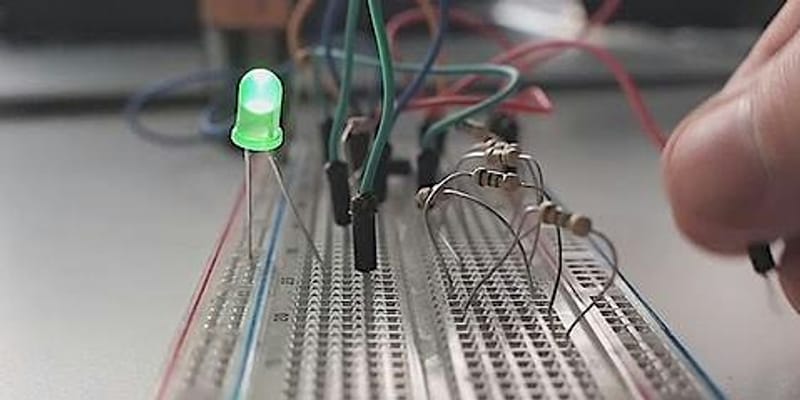
Are you interested in learning to work with electronics but don't know where to start? This class is for you!
- Shop: Electronics & Robotics
- Price: $300 (Standard). Scholarship tickets at half price, and Sponsor a Student tickets that help cover one, are also available.
- Materials fee: $30, paid to the instructor at the first meeting
- Instructor: Mike Beach and Andrew Anselmo
- Last offered: Tuesdays, October 6 - 27
Upcoming dates
This class isn’t scheduled right now. Get an email when Electronics & Robotics adds a class.
Past date
-
Tuesdays, October 6 - 27
7:00PM - 9:00PM · 4 sessions- Tuesday, October 6, 7:00PM - 9:00PM
- Tuesday, October 13, 7:00PM - 9:00PM
- Tuesday, October 20, 7:00PM - 9:00PM
- Tuesday, October 27, 7:00PM - 9:00PM
About this class
Have you been interested in learning to work with electronics but haven’t known where to start? This class is for you!
It will be a hands-on, practical crash course that will give you the skills to do simple electronic projects. You will walk away knowing the basics of circuit theory, how to prototype circuits on a breadboard, how to troubleshoot them, and how to solder them together. The class consists of four two-hour classes. In each class, we will complete at least one project, and you’ll go home with some fun things you have created.
Students who want more time at Artisan's Asylum to work on their projects can attend Artisans Asylum’s weekly Circuit Hacking Night on Wednesday Nights.
What you’ll learn
- Learn an overview of electronic terminology - and build some stuff!
- Learn how to make use of the E&R shop.
- Learn how to use a multimeter to measure voltage, current, and resistance.
- How to use a multimeter (DMM) to help solve your circuit problems.
- How to test and debug a circuit.
- What components look like and why we use them.
- Learn fundamental concepts pertaining to electricity and electrical components.
- Leave with basic skills that will enable you to take on independent projects.
- You’ll build and take home your own blinky light circuit, Drawdio noisemaker, Joule Thief battery vampire.
- Learn how to read basic schematics, proper use of a multimeter and oscilloscope, and various electron wrangling skills.
Who it’s for
Electronics beginners and folks who are curious about Artisans Asylum's Electronics & Robotics Shop. Students who are 12 years or older. All students under 18 must be accompanied by and under the direct supervision of a responsible adult.
Ticket includes
- Working with the following electronic components: Small breadboard, 2N3904 NPN transistor, Various Ohm ¼ W resistor, 3x LEDs of random colors, blue, red, green, or yellow, one white LED (with clear lens), Momentary push button switch, small diodes, Small potentiometer, 100uF capacitor, DC motor with brushes, Bundle of breadboard wires, AA battery holder with wires, 2x AA battery, Fresh 9V battery and holder, Velleman Flashing LED kit, MK102
- All the parts to build a Drawdio (based on a ‘555 timer, small speaker, a pencil, etc)
- Access to A2's E&R shop and tools for the duration of the session.
Prerequisites
Curiosity - and some patience.
Instructor: Mike Beach and Andrew Anselmo
Mike Beach is an Electrical Engineer, Asylum member since 2012, has taught and co-taught several courses, cares more about how the electrons are feeling than programming, really likes learning about and using all kinds of sensors, and just can’t stop showing how to use that oscilloscope to help you debug (just ask Kevin), and is an active participant and mentor at the Circuit Hacking night held at the Asylum every Wednesday.
In addition to his regular engineering work, Andrew Anselmo also volunteers as a shop lead and instructor at Artisan's Asylum in the Electronics and Robotics Shop. Integrating controls, sensors, actuators, and associated hardware is incredibly fun and always interesting. He also helps artists with kinetic art and sculpture projects and has taught them a few tricks for keeping their projects documented and easy to work on. He does a bit of origami and has been a street performer and instructor for many years. He’s designed a few novel and original origami models and made classic moving (kinetic) origami pieces out of metal. Origami is generally considered an art, but there is quite a bit of mathematics behind it.
Hear about new Electronics & Robotics classes
See how to get an email when Electronics & Robotics adds a class.