
All classes › Electronics & Robotics
From Sensors to Smart Systems
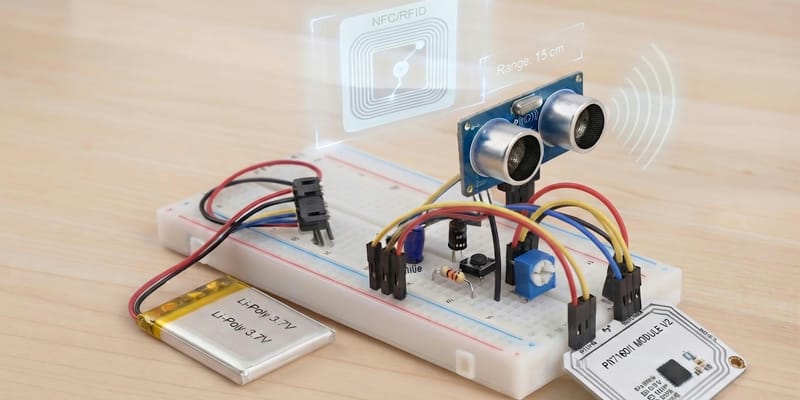
Learn how a machine makes sense of the world, and how to program sensors that make your own life better.
- Shop: Electronics & Robotics
- Price: $35
- Materials fee: $15, paid to the instructor at the first meeting
- Instructor: Khoi Ly
- Last offered: October 29 & November 5 & 12 & 19 & December 3
Upcoming dates
This class isn’t scheduled right now. Get an email when Electronics & Robotics adds a class.
Past date
-
October 29 & November 5 & 12 & 19 & December 3
6:00PM - 8:00PM · 5 sessions- Thursday, October 29, 6:00PM - 8:00PM
- Thursday, November 5, 6:00PM - 8:00PM
- Thursday, November 12, 6:00PM - 8:00PM
- Thursday, November 19, 6:00PM - 8:00PM
- Thursday, December 3, 6:00PM - 8:00PM
About this class
Students learn how an electronic system makes sense of its surrounding environment — how physical phenomena like motion, distance, and proximity are converted into electrical signals, how those signals are processed by a microcontroller, and how sensors can make an electronic system smarter through real, working closed-loop behavior. The course builds toward a final capstone project — a people-tracking device that distinguishes between someone who taps an NFC tag versus someone who simply walks by — giving students a complete, functioning piece of hardware they wired and coded themselves.
Materials provided include:
Arduino Uno
Breadboard
Jumper wire kit (M-M, M-F)
Potentiometer (10kΩ)
HC-SR04 ultrasonic sensor
MFRC522 NFC/RFID reader module
Extra NFC tags (2–3 more)
USB cable (A-to-B)
Misc. resistors / small parts
Digital multimeter (lending)
What you’ll learn
- What a transducer is, and the distinction between sensors and actuators
- The difference between analog and digital signals, and why both exist
- Core signal concepts: resolution, sample rate, range/resolution trade-offs, and aliasing
- Sources of sensor error: conversion error (quantization, aliasing), physical/external error (thermal effects, baseline drift, aging, hysteresis), electrical error (noise, power supply instability, wire resistance)
- How three real sensor types work: potentiometers (analog), ultrasonic range finders (digital timing), and NFC/RFID (digital protocol-based)
- The concept of feedback and closed-loop systems, including the sensor-brain-actuator model
- Fundamentals of how a microcontroller (Arduino) operates: timers, interrupts, GPIO, and communication protocols (SPI, I2C, UART)
- Basic circuit quantities — voltage, current, resistance, power — and how to measure them safely with a multimeter and other bench tools
- How to wire, code, integrate, and debug multiple sensors on a single microcontroller into one working system
Who it’s for
A complete beginner is okay.
The course is ideally better for high schoolers and up due to some mathematical explanations in the course
Ticket includes
- Access to A2's Electronic and Robotics and tools for the duration of the session.
What to bring
Laptop with the Arduino IDE installed
Pen and notebook
Closed-toe shoes
Natural fiber clothing (cotton), no loose sleeves or dangling jewelry, long hair tied back
Safety glasses (available at the space if you don't have your own)
Prerequisites
Complete beginner is okay.
The course is ideally better for highschooler and up due to some mathematical explanations in the course
Instructor: Khoi Ly
Hi, I'm Khoi. I've spent the last nine years building robots that do strange things — a swimming snake that splits itself in half, a Braille display driven by tiny butane explosions, a mole robot that digs its own tunnels — which somehow turned into a PhD in soft robotics and a day job designing embedded systems and circuit boards. And behind all of these fascinating systems are the sensors that bridge the physical world with perception, giving our circuits a way to make sense of everything around them, and that's exactly what we'll chase in this class.
Hear about new Electronics & Robotics classes
See how to get an email when Electronics & Robotics adds a class.